Home » Albury CBD Historic Buildings Walking Tour Digital Map
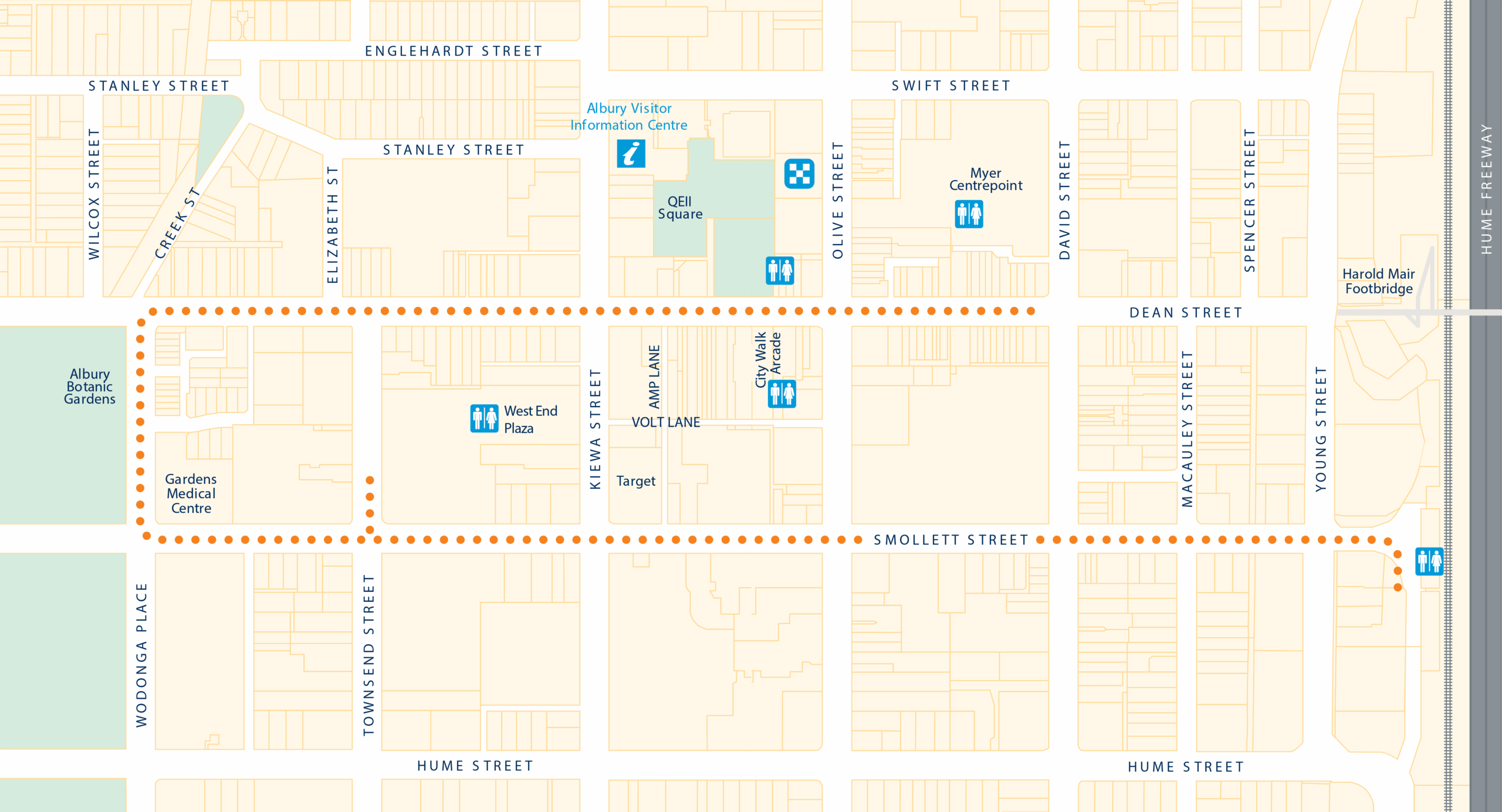
Taking you along Smollett and Dean Streets this tour showcases 21 sites over 13 locations. It is the perfect way to experience Albury’s beautiful CBD in the context of our rich, pioneering history.
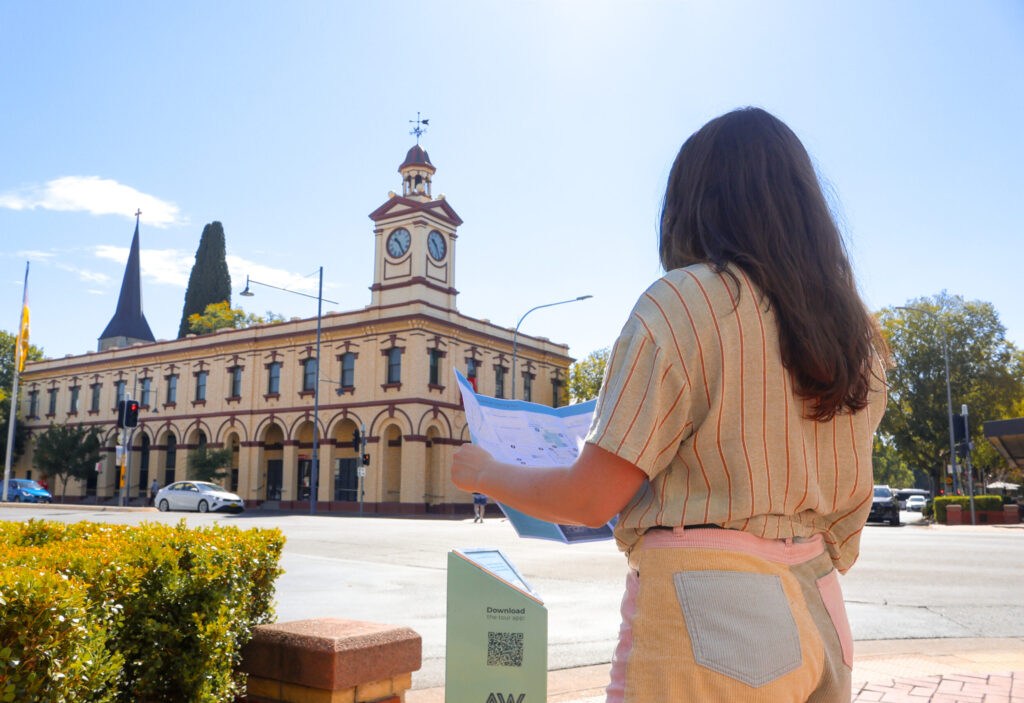
You are now standing in front of the former Albury Station Master’s Residence, built over 1881 and 1882.
Designed by Henry Deane, the original home featured a sitting room, dining room, scullery, pantry, kitchen, front verandah, and five upstairs bedrooms.
From the Station Master’s Residence, you can also see the Railway Station’s clock tower. Interestingly, the Station clocks were not installed at the time of construction. One reason why, was that until February of 1895, there was a 20-minute time difference between NSW and Victoria. It was only at this point that Eastern Standard Time was legislated in both colonies.
Designed in the grand Italianate manner and erected in 1881, Albury Railway Station was the last stop on the Great Southern Railways line, some 642 km from Sydney.
It was once one of Australia’s most important railway stations, acting as the transfer point for the change in rail gauge between NSW and Victoria.
Standard gauge between Sydney and Melbourne was only introduced in 1962. Until then, it was necessary for passengers to disembark on the eastern side of the Albury platform, and board a second train on the western side to travel into Victoria. This helps to explain the extraordinary length of the Station’s platform. At over 450 metres, it is one of Australia’s longest.
The former Waterstreet’s Hotel is a classic example of the late colonial style, two-storey country hotel.
The building was designed by Gordon & Gordon and erected in 1884 for Mrs Jane Poole, who also once ran the Railway Hotel just along Smollett Street.
Formerly the Commercial Hotel, the pub is better known for its ownership under the locally renowned Waterstreet family. But the hotel’s history extends beyond providing a daily libation for locals.
During the outbreak of Spanish Flu in Melbourne in 1919, people entering Albury from Victoria had to stay in isolation for one week. The men stayed at the Albury Sports Ground and the Wodonga Racecourse. Meanwhile, the women and children stayed here at Waterstreet’s Hotel, with a policeman on guard at the front door.
Known to local schoolkids as ‘The Castle’, the two-storey Albury Public School was built in 1891 by architect W.E. Kemp. You can see its Victorian style, and Queen Anne influence in the fine detailing of the brickwork and terracotta elements.
The Castle was the third schoolhouse to be erected in Albury. Albury’s original National School was built on the corner of Dean and Kiewa Streets in 1850. However, commercial interests saw a push to relocate the school and, by 1861, the building on Olive Street was opened. It is still in service today and has been placed on the Register of the National Estate.
Albury’s first Catholic Church was built here in 1858. Twelve years later, on August 21, 1870, the Reverend Dr Michael McAlroy laid the foundation stone of Saint Patrick’s.
Construction took over two years, and the church was officially opened on November 24, 1872. The decorative window and door dressings you can see today remain unchanged since the 1870s, and were made from purple sandstone quarried at nearby Table Top over 140 years ago.
The stained-glass windows were the work of Australia’s first stained glass artist, John Falconer, who included the names of many of the founding donors in his designs. Other buildings you can see include St Patrick’s Presbytery to the right of the church, and St Joseph’s Monastery along Smollett Street.
The grand old building before you was once Australia’s largest inland woolstore. In its heyday, it had a 104-metre frontage along Smollett Street and, with total floorspace at a whopping 2.75 hectares, could warehouse 12,000 bales of wool.
The Farmers & Graziers Woolstore was, for many years, also home to Albury’s annual Trade Fair, an important exhibition for local manufacturers, retailers and primary producers, and the source of fond memories for generations of Albury families.
Even today, the Woolstore is a powerful and poignant reminder of the importance of the wool trade in the development of our nation.
Apart from several hotels, Kia Ora was Albury’s first major commercial building, opening its doors as The Bank of New South Wales on June 1, 1858.
Built at a total cost of £3,914, the building was described at the time as ‘… an ornament to the town and a standing monument to the value of Albury granite’ Commanding a salary of £400 per annum, plus £2 a week for a horse and servant. Mr John Walker Jones was the inaugural bank manager for 35 years.
Kia Ora has since served as a residence, a stock and station agency, a music academy, and part of the New South Wales Health Service.
The Albury Botanic Gardens were opened by Mayor William Jones in 1877. The Gardens were originally laid out in the form of a Union Jack, a fact even many locals are not aware of.
Inside the main gates which commemorate another Albury mayor by the name of Robert Wilkinson, you’ll find an award-winning collection of over 1000 plant species, sprawling over 10 acres.
These species include a Queensland Kauri, which is over 46 metres tall, as well as a Lone Pine from Gallipoli, planted in the Gardens on Anzac Day of 1936. The tree was hit twice by lightning, and the Lone Pine standing proudly in the Gardens today was nurtured from one of many seedlings collected from the original Pine.
The Beehive Buildings are of enormous architectural significance to Albury.
Built between the 1850s and 1880s, tenants of these buildings have included the Fanny Ceres Flour Mill as well as a chemist, a stock and station agent, saddler, tailor, sports store, and the offices of prominent local architect, Louis Harrison.
Also known in recent times as the Moys Buildings, the Victorian stuccoed façade and neo-classic style of the Beehive Buildings are an iconic part of the city’s main street.
The Globe Hotel across the road to your left was built for John Roper, a member of Ludwig Leichhardt’s 1844 expedition from Brisbane to Port Essington.
The Roper River in the Northern Territory is named after him, and he was Albury’s first Clerk of Petty Sessions in 1847.
In 1859, when the New South Wales government decided the Sydney Road running through Albury would encompass Kiewa and Dean Streets, the enterprising Roper saw a business opportunity.
He commissioned the design and construction of a two-storey, eighteen-room hotel with stables – and The Globe opened to travellers and locals alike in October of 1860.
Diagonally across the intersection, you’ll see the building that now houses the Albury Post Office. Its origins date back to 1861, when its main function was as the Telegraph Office.
In 1877, a revamped Post Office was designed in the Victorian Free Classical style by James Barnet and built by Alexander Frew.
The building included private accommodation for the postmaster, stables, and a buggy house. The first floor comprised six rooms and incorporated the clock tower.
You might see similar turret clocks in Forbes, Orange, Dubbo, Lismore, Tamworth and other regional centres – all the work of Angelo Tornaghi, a renowned clockmaker of the late 1800s.
The clock here in Albury first struck in November of 1879. 132 years later, in 2011, the Albury Post Office was placed on the Commonwealth Heritage List.
Look directly across Kiewa Street to your right and you’ll see one of Albury’s most iconic edifices – the Mate’s Building.
Standing on a landmark corner that was originally occupied by Albury’s first National School, the land was purchased by T. H. Mate in 1860 for £700.
The original 1850 Mate’s Building was destroyed by fire and replaced by the current structure in 1915, with a full second storey being added in 1929.
In Albury’s blazing summers of the 1940s and 50s, Mate’s was the store to purchase such essential items as pure wool swim trunks, lightweight pyjamas, electric fans and square hand water bags.
Later major tenants included Waltons and Venture, before the building underwent major redevelopment in 1987.
Over Dean Street just to your left is the Albury Court House. When it was built in 1860, it overlooked little more than a swamp.
Designed by colonial architect Alexander Dawson and built by Thomas Allen, the stonework façade and portico are in the Classic Revival style. The adjoining two-storey building at the rear was formerly the caretaker’s cottage.
Inside the Court House, features of a bygone era include the two holding cells at the rear, an iron-railed dock, an original painted coat of arms, and a press gallery where, traditionally, journalists have carved their names.
Despite a modern courthouse being opened around the corner in Olive Street in 1987, the original Court House remains fully operational for selected hearings.
The building to your right was the City’s original Town Hall. Intended to show the ‘energy, enterprise and grit’ of a district recovering from harsh times, the Town Hall was officially opened on July 17, 1908.
The building’s architecture is a good example of the Federation Free Classical style, prevalent from 1890 to 1915.
The Town Hall served as a recruitment office during both World Wars, and was a Red Cross depot where women gathered to sew garments in support of the war effort.
In 1981, the Town Hall was redesigned by architect, Rob Stynes, working with advice from Albury’s first Regional Art Director, Audray Banfield. The building was officially re-opened on the 29th of June as the Albury Regional Art Gallery.
The building was transformed once more in 2014 to include a modern extension and incorporate the old Lands Office next-door. Murray Arts Museum Albury, known locally as MAMA, opened to the public on the 2nd of October 2015.
Over the road to your right, you’ll see a building topped by fine statuettes.
The Latin inscription below these figures reads ‘Amicus Certus in re incerta’ and the closest English translation is ‘A sure friend in an unsure world’. It’s an appropriate motto for the AMP Building.
Built in 1940 to replace dilapidated commercial and retail shop fronts, it was designed by Albury architect, S. S. Oxenham, who also designed other prominent Albury buildings such as the Masonic Hall in Kiewa Street.
Its three storeys showcase a symmetrical facade, with subdued spandrels between the second and third storeys to emphasise a vertical appearance.
Directly in front of you is the T&G Building.
Evoking the 1930s New York ‘skyscraper’ style, the four-storey tower was built in 1940 as an addition to the existing three-storey building of shops, offices and a billiard parlour.
The tower rises to a height of around 26 metres and is emphasised by the vertical treatment of the windows.
To this day, the T&G Building stands as one of Albury’s landmark buildings and remains in a virtually unaltered state.
The imposing two-storey building directly across Dean Street is nowadays the Murray Conservatorium of Music.
Built in the Classic Revival style, it has graced the eastern end of Albury’s civic block since 1886, and was originally used as a Telegraph Station to cater for the burgeoning telegraphic traffic.
It featured a public lobby, large battery room, offices, parlour, and storeroom on the ground floor, with private accommodation for the Telegraph Station Master on the upper floor.
From 1888 until 1904, it also incorporated the telephone exchange. The building served as a trade school and museum, before becoming home to the Riverina Music Centre in 1981. That same year, the NSW Heritage Council placed a permanent conservation order on the building.
Looking diagonally across the intersection, you can see the original location of the Union Bank.
The site was once a popular campsite for travelling side shows and was later purchased by Joe ‘Walnut’ Ormiston, who earned his nickname from the enormous walnut tree that once stood on the site.
The bank building was constructed by Frew and Logan in 1907. It featured a small banking chamber and strong room in the centre, with a manager’s residence on the second floor.
The building spent many years as ANZ Bank, later becoming Angus & Robertson’s Bookstore, but eventually returned to its banking roots as home to WAW Credit Union.
To the right, across Olive Street, is another of Albury’s prestigious commercial buildings. The CML Building was erected in 1925 and extended to its present size in 1938.
Its most obvious attribute is the five-story clock tower, which has, for almost a century, helped to define Albury’s main street.
The building was designed by prominent Melbourne architect, Nahum Barnet, who was regarded as Melbourne’s most innovative producer of commercial buildings during the Federation period.
His commissions include Her Majesty’s Theatre, the redevelopment of the St Kilda Synagogue, the former Empire Building on Flinders Street, the Wertheim Piano Factory in Richmond, and the Melbourne Synagogue in South Yarra.
The Regent Cinema, diagonally across the intersection and just along Dean Street, is one of a number of movie theatres to have operated in Albury during the golden age of cinema.
Others included the open-air Olympia, Plaza Theatre and Hoyts, which was located on Olive Street from 1937 right up until 1972.
The Regent was opened in 1927, and its external art deco influences are obvious. Inside, elaborate decorative plaster mouldings exude the grandeur and elegance of the Roaring Twenties.
The original theatre seated 1286 movie-goers, and, from the late 1940s, circle patrons were able to stroll out to a rooftop garden, where a waterfall disguised the cooling tower.
The Regent Theatre is listed as part of the Heritage Trust of Australia and is an important landmark for the City.
The building to your right, on the other side of David Street, was originally the site of Thomas Delaney’s Bedding Factory, which operated for 20 years until Betro Abikhair built the present store in 1911.
Then known as the ‘Australian Building,’ it soon became popularly known as ‘The Big Store.’
Designed in the Commercial Federation style, note the building’s detailed parapet and the Australian coat of arms on the corner façade.
The Big Store, now over a century old, remains an important architectural character of Albury.